
By Metropolis Corp | Updated October 2026
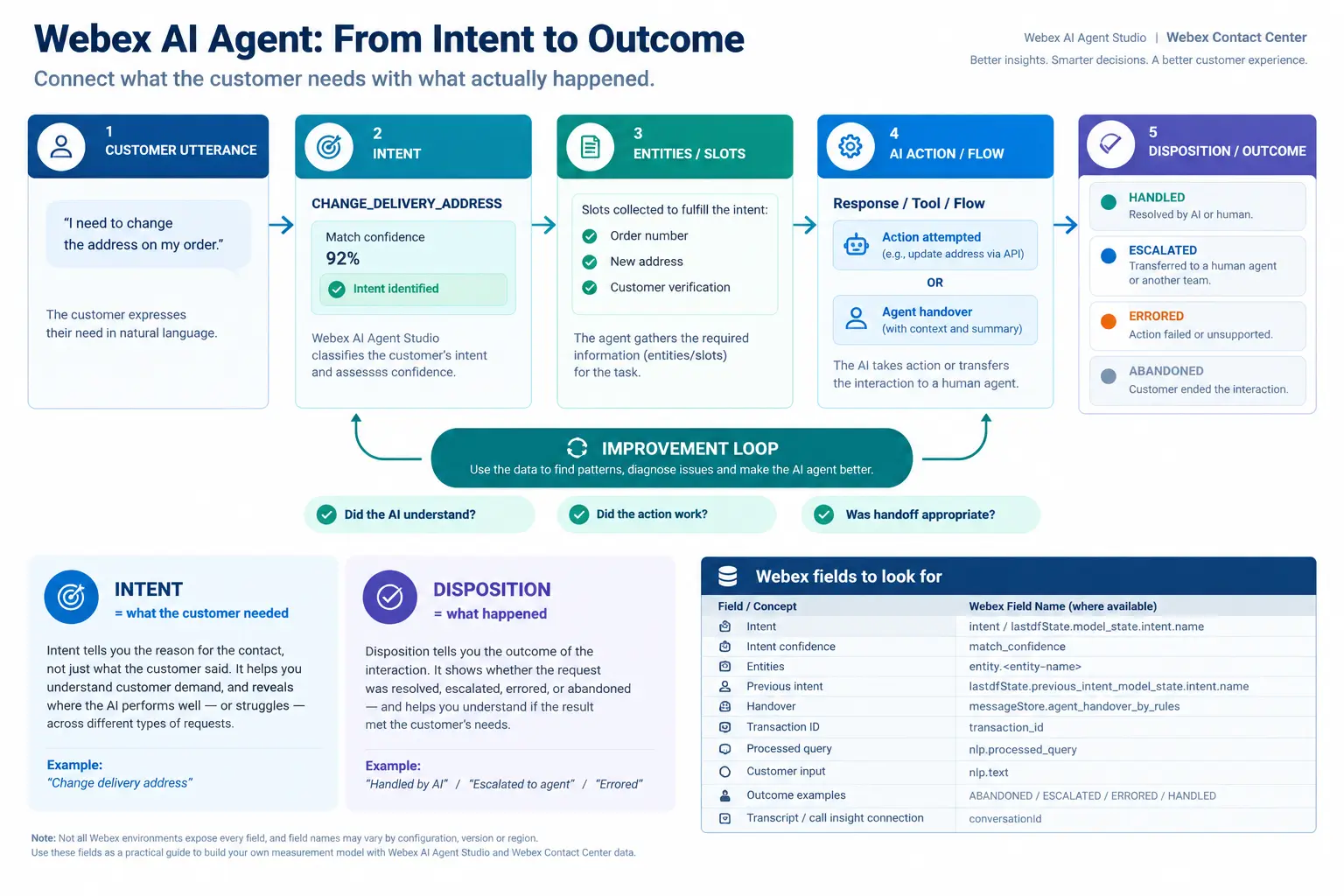
An AI agent does not become better merely because it handles more conversations without a transfer. It becomes better when it understands what customers need, completes appropriate tasks reliably, recognizes when a person should take over, and preserves the context needed for that person to help quickly.
A high AI Containment Rate can look impressive while customers are repeatedly calling back, abandoning interactions, or being transferred to the wrong team. Conversely, an AI agent with a meaningful escalation rate may be performing exactly as designed if it recognizes when a human needs to take over.
The most useful way to understand AI-agent performance is to connect two pieces of information:
Intent: What did the customer need?
Disposition: What happened as a result?
Together, this data gives you the insight needed to identify where an AI agent is succeeding, where it is creating friction, and what needs to change to make the customer experience better.
Intent is the reason the customer contacted your organization. It describes what the customer is trying to accomplish, rather than simply what they said.
A customer might say, “My package was supposed to be here yesterday. Where is it?” The intent could be Order Status or Track Order.
Other common intents include:
Intent gives an AI agent a structured understanding of customer demand. That matters because an agent may perform very differently depending on the customer's reason for calling. An agent could resolve 95% of order-status questions while struggling with address changes. Looking only at overall containment would hide that difference.
Intent can also include the entities or slots required to complete the request. For an address change, that might include the customer's identity, order number, current address, new address, and verification information.
Note: This creates an important distinction: an AI can correctly understand the customer's intent but still fail to complete the task.
Disposition describes what happened during or at the end of the interaction.
Depending on the organization, dispositions might include:
Intent and disposition become most useful when they are connected. Consider a customer whose intent is Change Delivery Address. That interaction could result in the address being changed by AI, a transfer to fulfillment, an API failure, customer abandonment, or a human agent completing the request.
The intent tells you what the customer wanted. The disposition tells you what happened to that request. That combination gives you a much clearer picture of the customer journey.
Suppose an AI agent handles 10,000 conversations and avoids transferring 8,000 of them. That sounds positive. But what if customers in those 8,000 conversations subsequently call back because their problems were not actually solved? Or what if the agent performs well across most intents but consistently struggles with one high-volume request?
Breaking the data down by intent and disposition can reveal the difference. You might discover that:
Order Status: High volume and high AI resolution.
Password Reset: High volume but significant repeat contact.
Billing Disputes: Frequent human escalation, but that escalation is appropriate.
Address Changes: Low resolution because a downstream API frequently fails.
Those are four very different problems, even if they are all counted simply as “AI interactions.”
One of the most common mistakes in evaluating AI agents is treating every human transfer as a failure.
Some requests should be escalated. A customer may request a person. A transaction may require human approval. A situation may involve fraud, an exception, a sensitive account issue, or a policy that requires human judgment.
Was the escalation appropriate, correctly routed, and useful to the human agent?
A good AI-to-human handoff should preserve relevant context, including:
That makes the human interaction a continuation of the customer journey rather than forcing the customer to start over.
You may already have much of this information. Modern contact-center and AI-agent platforms increasingly expose intent, outcome, transfer, and conversation data through their analytics, session records, APIs, and reporting tools.
Zoom Virtual Agent: Data can include matched intents, intent accuracy, engagement outcomes, interaction duration and turns, knowledge articles and retrieval information, tools or skills used, transcripts, and transfer information. Where enabled, Zoom also provides an implicit-resolution result that can help determine whether an interaction appears to have been resolved.
Webex AI Agent Studio: Session and transaction information can include intents, confidence, and entities or slots. Webex Contact Center can also carry virtual-agent information through the flow, including the last detected intent and a transcript reference. Its reporting capabilities can be used to analyze AI Agent Call Records and outcomes such as handled, escalated, errored, and abandoned interactions.
The exact fields and terminology vary by platform, but the underlying concept is the same: look for the data that connects what the customer wanted with what ultimately happened.
The correlation ID is particularly important. It should allow the AI session to be connected to the contact record, transfer, human interaction, CRM case, and final transaction or business outcome.
Once intent and disposition are connected, investigate the patterns rather than simply watching overall AI performance.
| Pattern Identified | Root Cause Analysis & Action Item |
|---|---|
| High-volume intent + poor resolution | A large number of customers may be experiencing the same problem. Review the entire journey. |
| High-confidence intent + poor outcome | The AI understands the customer perfectly but cannot complete the action. Inspect authentication, workflows, APIs, and downstream systems. |
| High escalation + successful human resolution | The escalation may be intentional and appropriate rather than an AI failure. |
| Low escalation + high repeat contact | The agent may be ending conversations successfully from a reporting perspective while failing to resolve the customer's actual need. |
| High abandonment for one intent | Look for friction in authentication, repeated questions, unsupported requests, long transfers, or an inability to complete the action. |
This approach also helps assign problems to the right team:
An intent-recognition issue belongs with the AI or conversation-design team.
An API failure belongs with IT or the application team.
A routing problem belongs with Contact Center operations.
To put intent and disposition into practice, contact center teams must look beyond overall containment numbers and track performance at the session level. Measuring these metrics requires aligning platform telemetry with business outcomes across three main dimensions:
Intent Resolution Efficiency: Calculate the completion rate per intent by pairing detected intents with final transaction statuses (e.g., successful API payload vs. abandoned session).
Escalation Quality: Track post-transfer metrics, such as live-agent handle time and transfer destination accuracy, to verify if the AI properly qualified the customer before handing off.
Repeat Contact Correlation: Link AI interaction IDs with 72-hour repeat contact data to flag instances where the AI reported an interaction as "resolved," but the customer was forced to call back.
When these metrics are tracked systematically across AI session logs, CRMs, and call detail records, teams gain the exact roadmap needed to continuously refine conversational flows, fix integration bottlenecks, and elevate overall customer experience.


