
By Metropolis Corp | Updated August 2026
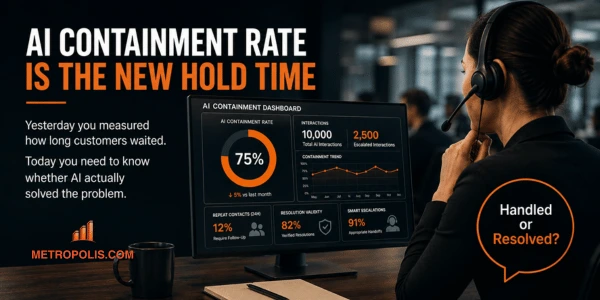
Yesterday you measured how long customers waited. Today you need to know whether AI actually solved the problem.
Every contact center adopting AI eventually starts tracking the same metric: AI Containment Rate.
At first glance, it seems like the perfect measure of success. High containment means your AI is handling work so you do not have to. Low containment means you built an expensive IVR replacement that nobody wants to use.
But containment is also one of the easiest metrics to misinterpret. A high containment rate doesn't automatically mean customers are getting the help they need.
If your organization is deploying AI voice or chat agents, you cannot afford to ignore this metric.
At its simplest, AI Containment Rate measures the percentage of customer interactions that enter an automated system (voice or digital) and are handled completely within that channel without ever being transferred or escalated to a human agent.
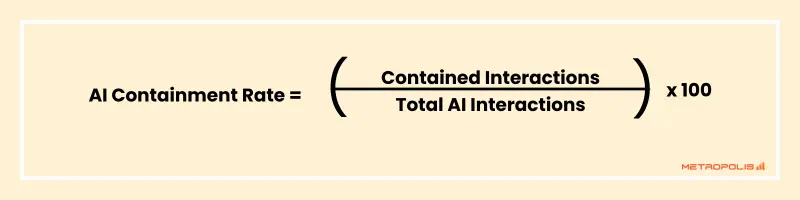
For example, if an AI voice agent answers 10,000 incoming calls this month, and 2,500 of those calls end up transferring to a live representative, your raw containment rate is 75%.
In a traditional contact center framework, that 75% looks like a massive operational win. It suggests you just saved 7,500 human conversations. But in an AI-driven workforce, that raw number only tells half the story.
When managed correctly, AI Containment Rate is the single best indicator of how well your self-service strategy is performing. Here is why every CX leader, IT director, and voice engineer needs it on their core dashboard:
Generative AI models, speech recognition engines, and orchestration layers are not free. Containment rate tells you whether your investment is actually reducing demand on human agents or simply adding another step before customers reach one.
A sudden drop in containment for billing, password resets, or order changes often points to a problem with intent recognition, missing integrations, or outdated knowledge. It tells your voice engineers that the model is either misunderstanding user intent, lacking integration with the system of record, or missing crucial knowledge articles.
Knowing your true containment rate allows you to project staffing needs accurately. If your AI consistently contains 60% of tier-one calls, your human agents can shift away from repetitive tasks like password resets and focus entirely on complex, high-empathy customer issues.
Here is where containment becomes misleading.
Containment measures whether a call ended in the AI channel. It does not measure whether the customer’s problem was actually solved.
If a customer calls in, gets stuck in a repetitive loop with an AI that refuses to transfer them, and eventually hangs up out of pure frustration, your legacy system logs that call as "contained".
That is not containment. That is customer abandonment masquerading as operational efficiency.
If you optimize for containment in a vacuum, you incentivize teams to make human escalation harder. They hide the option to speak to a representative, loop the user through endless clarifying questions, and watch their containment rate skyrocket while their CSAT collapses.
To turn Containment Rate into a true measure of success, you have to pair it with verification safeguards.
A call should only be provisionally marked as "contained". If that same customer calls back or opens a web chat within 24 hours regarding the same topic, that first interaction was not contained. It failed. Adjusting your numbers for repeat contacts typically reveals a 5% to 15% gap between raw containment and true resolution.
Never read containment on its own. Pair it with a Resolution Validity Rate. Have a human audit a randomized sample of contained conversations against ground-truth data to confirm that the AI actually completed the workflow or provided correct information before the customer hung up.
A 100% containment rate should never be the goal. High-value, complex, or highly sensitive conversations should transfer to a human. You need to measure whether the AI is holding onto calls it ought to be escalating, or passing them over smoothly with full context when a human touch is required.

AI Containment is an efficiency metric.
AI containment measures whether the AI kept the conversation. Resolution measures whether it deserved to.
If you use containment to celebrate how fast you got a customer off the line, you are building a system that traps users instead of helping them. But if you use containment as a baseline to measure genuine, verified problem resolution, you will build an automated workforce that saves money, empowers your human team, and keeps your customers coming back.
Whether you're deploying Webex AI Agent, Zoom AI, or another AI-powered customer service platform, Metropolis can help you measure true AI Containment Rate. Ask us how.
There is no universal benchmark, as ideal targets vary by industry and query complexity. Rather than targeting an arbitrary figure like 80%, focus on achieving high containment for simple tier-one requests (e.g., password resets) while maintaining high Resolution Validity Rates and customer satisfaction.
Containment Rate measures whether an interaction remained within the automated channel without agent involvement. FCR measures whether a customer's issue was resolved completely during their first contact, regardless of whether it was handled by AI, a human, or both.
Yes. Metropolis analytics integrates across multi-vendor UC and CCaaS systems—including Webex, Zoom, and Cisco environments—to provide cross-platform visibility into true containment and customer journey analytics.
Get full visibility into your automated interactions, eliminate false containment, and optimize customer experience with analytics from Metropolis.
Contact Metropolis Today


