How to Catch AI Accuracy Drift and Hallucinations Before They Hurt Your Contact Center
Is your AI agent continuing to perform reliably?
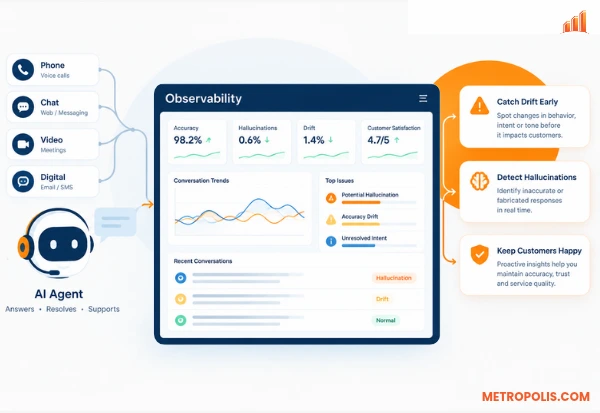
An AI agent can work well during testing and still develop problems later as knowledge sources change, integrations are added or prompts are updated. Even small configuration changes can affect how an AI agent responds.
That makes AI agent observability an increasingly important part of contact center operations.
Human (traditional) contact center reporting focuses on what happened during an interaction. How long did it last? Was it transferred? Which queue handled it?
How the interaction end - a hang-up or abaondonment? AI agents change this up a bit. Organizations now need to understand what the AI agent itself did, whether it followed its instructions, whether the information it provided was accurate, and whether its behavior is changing over time. AI agent observability brings those questions into an ongoing monitoring process. It can include signals such as: Accuracy and response quality Hallucinations or unsupported answers Changes in escalation patterns Unexpected increases in failed interactions Changes in customer behavior after an AI interaction Performance by AI agent, workflow, or use case Changes following prompt or knowledge-base updates Emerging customer questions the AI cannot handle reliably Feedback from customers, agents, or supervisors Differences in performance across channels or customer segments
Agent Observability spots meaningful change early, so your team fixes it before customers feel it. AI agents operate in environments that are constantly changing. Consider an AI agent designed to answer questions about billing. At deployment, its knowledge base may contain accurate information about payment methods, billing cycles, and account changes. Six months later, the company introduces a new payment process. The AI agent may continue responding confidently using information that was correct when
it was deployed. Nothing necessarily appears broken at the infrastructure level. The agent is online and customers can reach it. And conversations are being processed. All good, right? Not quite. The quality of the experience has changed. This is accuracy drift. The same problem can occur when prompts are modified, new tools are connected, policies change, or customers begin asking questions that were
not represented in the original testing data. That is why AI monitoring cannot stop at availability or utilization. One of the more difficult AI agent problems is that an incorrect response can sound completely reasonable. A traditional application may return an error when something goes wrong. A generative AI system can produce a fluent answer that is simply not supported by the organization's information. Observability should therefore look for signals that indicate an AI agent may be producing unreliable responses. Depending on the environment, useful signals can include: Customer corrections or negative feedback Repeated questions within the same interaction Escalations following an AI response Human agents correcting information provided by AI Questions that repeatedly fall outside the AI agent's knowledge Unexpected changes in conversation paths Increased use of fallback or transfer mechanisms Responses that conflict with approved business information
These signals become much more useful when they can be analyzed over time and compared against a baseline.
If your Webex AI Agent quotes outdated information, such as an old return deadline, first work out whether it repeated stale content or invented something.
In Webex AI Agent Studio, start in Sessions
to find the conversation, then check the knowledge base's source information and activity history and the agent's version history and change log to see what changed and when. For website-based sources, use manual sync with hold changes for approval. The review lists added, modified, and deleted content, so you can confirm the revised policy was captured before agents see
it. After approving, test with a few questions in chat preview, then watch production sessions. Log the sync date and any instruction changes so you can compare answers against the correct policy and configuration. Webex may supply the evidence, but it is still up to your team to define the accuracy checks that turn it into agent drift monitoring system. Zoom agents take actions as well as answer questions, so check that what the agent said matches what it did. Say a customer hears "Your refund has been submitted," but the transaction never completed. Open the
Engagement Log, review the transcript and Agent Tracing, then compare it to the order system's transaction record. That shows whether this was a conversational
failure (success claimed without evidence) or an execution failure (the backend request failed). Before publishing revised guidance, use Evaluation to run the current and proposed versions against the same scenarios. Compare scenario success rates, behavior-match scores, and test transcripts.
Include a regression case that simulates a failed refund, and confirm the agent reports the failure or escalates instead of claiming completion. Note: Rising escalations or negative feedback don't prove hallucination on their own. They flag conversations to check against approved knowledge or verified transaction outcomes. AI observability is also why organizations should be cautious about relying on a single headline metric. Take containment, for example. It tells you how often an interaction stays with the AI instead of reaching a human, which is useful operational
information, but it doesn't explain everything about how the AI is behaving. (We go deeper on this in
AI Containment Rate Is the New Hold Time, our look at containment as a contact center metric.) Observability asks a different question: Is the behavior behind that metric changing? An AI agent can hold a steady overall containment rate while performance quietly deteriorates in one customer use case. That's why observability works best when it looks at AI performance at a more granular level. Customer intent is another useful dimension, but it should not be confused with observability itself. Intent tells an organization what the customer was trying to accomplish. Disposition helps describe the outcome of the interaction.
Learn more about how Intents and Disposition can Improve AI Agent CX
For observability, those dimensions become useful as ways to identify where an AI agent is changing. For example: Overall AI performance: Stable Billing-related interactions: Increasing escalations Password-reset interactions: Stable Order-status interactions: Increasing repeat contacts The aggregate number may not immediately signal a problem. Breaking performance down by use case can reveal where the AI agent is beginning to struggle. AI agents are dynamic systems operating in dynamic environments. The next stage of enterprise AI is operating them responsibly at scale. Observability provides the visibility needed to know when they are working, when they are changing, and when it is time to intervene.What Is AI Agent Observability?
Why AI Agent Performance Can Drift
Detecting Hallucinations and Incorrect Responses
Tracing Knowledge Changes with Webex AI Agents
Zoom Virtual Agent - Following the Execution Path
Don't Rely on One AI Metric
Connect AI Behavior to Customer Intent
AI Agents Are Dynamic, They Need Observability
Related Topics
-

-
-
-

-
AI Agents vs Human Agents in Call Centers
Performance Guide for Hybrid Call Centers -

How VoiceLake for Fabric Works
Agentic Communications Data