VoiceLake: The Agentic Communications Data Layer for Microsoft Fabric
A Preview workload that brings supported calling and contact center records into a Lakehouse in your Microsoft Fabric workspace, ready for analytics, AI and applications. Here is how it works.
Your calls in a Lakehouse. Your reports on your own Copilot.
Communications data is valuable. It tells you who called, where the call went, how it was handled and what happened next.
But getting that data into a form that data and AI teams can actually use can be difficult. Every communications platform has its own APIs, data structures and terminology. Building integrations for each one creates another pipeline to maintain before a developer can even begin working with the data.
VoiceLake changes that.
The VoiceLake workload from Metropolis connects Zoom Phone, Zoom Contact Center, Webex Calling, Webex Contact Center, Microsoft Teams calling and Five9, structures each platform's data and syncs it into a Lakehouse in your Microsoft Fabric workspace.
Instead of building telephony data pipelines first, your team can work with communications data directly in Fabric, Microsoft Power BI, AI workloads and applications.
No custom ETL. No separate communications data silos.
What this means for Fabric users
VoiceLake gives Fabric teams a communications data foundation they can build on.
Bring supported call and contact center data into a Lakehouse in your Fabric workspace.
Work with documented, per-platform tables and dimension tables shared across the report models, instead of raw vendor API payloads.
Start with ready-made Power BI reports and a semantic model.
Build your own reports, measures and analytics on the supplied data.
Combine communications data with other business data where appropriate keys and permissions are available.
Build AI agents and applications without first building the underlying telephony data pipelines.
VoiceLake handles the communications data foundation. Your Fabric team decides what to build with it.
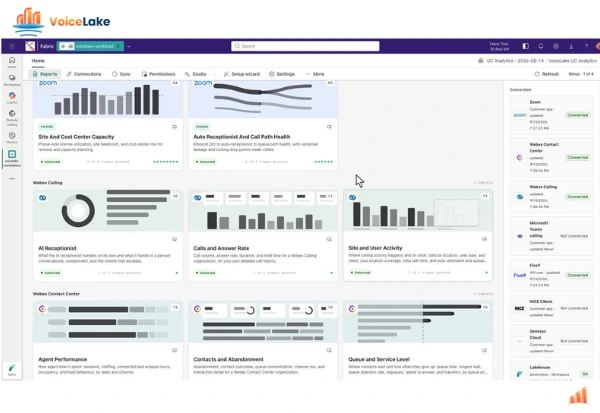
From communications data to business context
Consider a simple question: how are calls distributed across locations, users and client types?
VoiceLake can bring the underlying calling records into Fabric so that question can be answered in Power BI. A supplied report might provide the initial view, while the underlying semantic model and Lakehouse tables give a data team the ability to go further.
The same data can support questions that are specific to the business rather than the communications platform.
For example, a team might want to relate call activity to its own organizational structure, analyze activity by business unit or combine communications data with other operational data.
The real value is having your communications data in Fabric, structured and ready for your team to build the analysis, AI, and applications they need.
Communications data is becoming AI data
The same shift is happening with AI-driven calling.
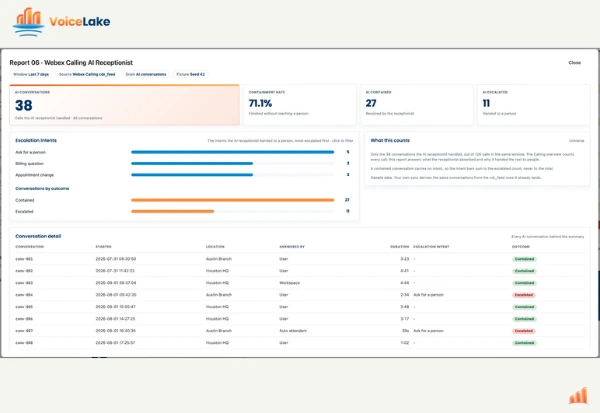
AI receptionists create new questions that traditional call reporting was never designed to answer. How many conversations stayed with the AI? How many escalated to a person? Why did they escalate?
A VoiceLake AI Receptionist report can surface measures such as containment, escalations and escalation intents. In a Metropolis sandbox example, 38 conversations included 27 contained and 11 escalated, producing a 71.1% containment rate. These are test calls, not customer results.
Containment alone does not prove that a caller's request was resolved. But having the underlying conversation data available in Fabric gives data teams a foundation for asking more sophisticated questions and defining the measures that matter to their organization.
This is where communications data starts to become part of the broader enterprise data and AI strategy.
VoiceLake Studio: reshape your reports with your own GitHub Copilot seat
VoiceLake provides the communications data foundation. Your Fabric team can build AI agents and applications on the landed tables without first building and maintaining the telephony pipelines required to collect and structure them.
The architecture is straightforward:
Communications platforms → VoiceLake → Fabric Lakehouse tables → Power BI reports, and the analytics, AI agents and applications your team builds
VoiceLake handles the communications connectivity, structuring and data modeling. Fabric provides the environment for analytics, models and AI workloads.
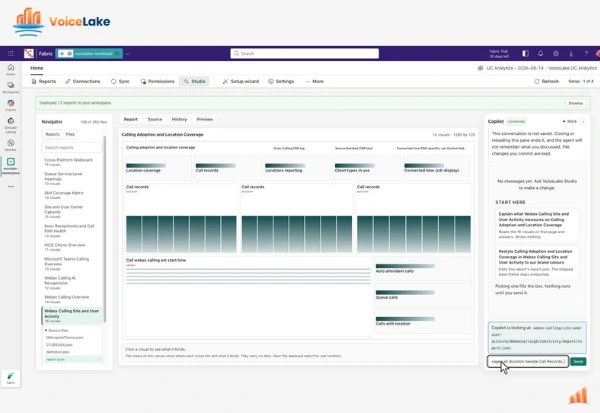
VoiceLake Studio, inside the Fabric item, puts a report workbench beside a coding agent that runs on your own GitHub Copilot seat. You ask for a change to a report in plain language, a new measure or a different cut of a page, and the agent works on the report definition. In agent and plan modes it asks for approval before it writes; autopilot mode runs without prompts, and the workbench says so while it is on. In every mode the semantic model folder stays write-protected, with measures the one change allowed through a validated route.
GitHub Copilot is not required to land communications data or to use the supplied reports and model. Studio's coding agent does require your own GitHub Copilot seat, so no inference is billed through Metropolis and the agent runs under your own Copilot entitlement and policies.
The fundamental change is simple:
Developers can build against communications data instead of building the communications data pipeline first.
One data foundation, many possibilities
A Power BI report may be the starting point. But the same structured communications data can support business-specific models, analytics, AI agents and applications.
That is the opportunity VoiceLake brings to Microsoft Fabric: communications data becomes another usable enterprise data source, ready for your team to build on.
VoiceLake is in Preview. The Fabric workload is published to selected tenants and Metropolis guides your onboarding. The subscription is listed on Microsoft Marketplace as VoiceLake UC Analytics for Microsoft Fabric, with a 14-day trial.
Talk to our data team about a VoiceLake trial
Ready to bring your calling and contact center data directly into your Microsoft Fabric Lakehouse?
Learn about VoiceLakeMicrosoft, Microsoft Fabric, Microsoft Power BI and Microsoft Marketplace are trademarks of the Microsoft group of companies.
Related Topics
-

-
-
-

-
AI Agents vs Human Agents in Call Centers
Performance Guide for Hybrid Call Centers -

How VoiceLake for Fabric Works
Agentic Communications Data