
By Sharon Harry | Updated May 2026
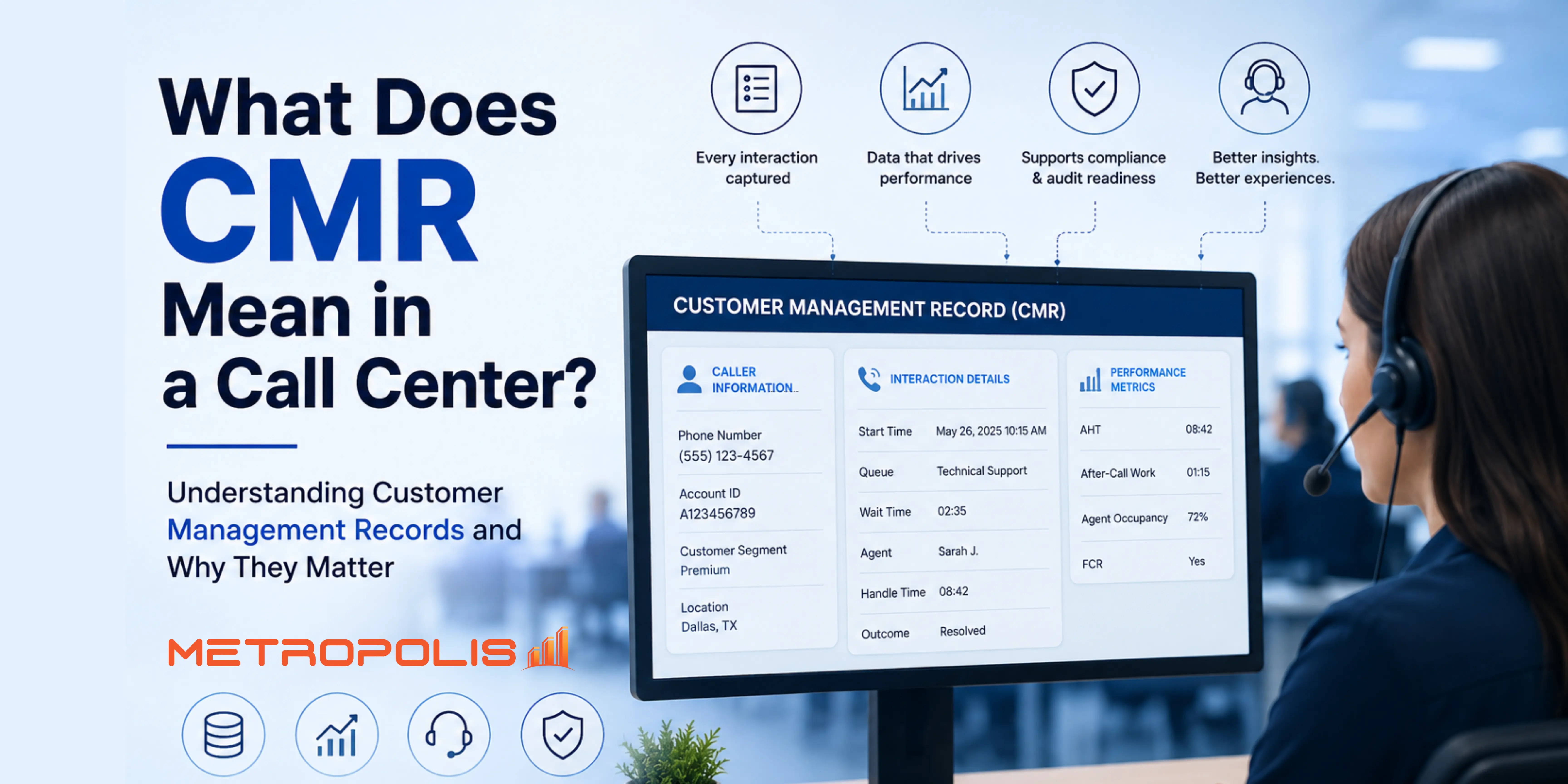
In call center operations, CMR stands for Customer Management Record.
A CMR is the digital fingerprint created whenever a customer interacts with your contact center. It captures important, contextual details about the lifecycle of the interaction—including who reached out, what happened during the queue phase, how long the conversation lasted, and exactly how the issue was resolved.
Think of a CMR as the data trail behind every customer conversation.
While frontline agents focus on resolving customer inquiries in real time, supervisors, QA managers, and operations analysts rely on CMR data behind the scenes. It is the core dataset used to improve service quality, troubleshoot complex routing issues, and power broader call center analytics.
A true Customer Management Record isn't just a simple timestamp. It merges system data with human operational inputs to provide a comprehensive view of an interaction, typically broken into three structural categories:
Phone number / ANI
Customer account ID
CRM record linkage
Geographic origin location
Customer segment (e.g., VIP, Standard)
Call start, connect, and end times
Queue path entered
Exact wait/queue time
IVR menu selections path
Agent assigned & transfer history
Hold duration & frequency
Wrap-up/disposition codes
Final call outcome status
Beyond basic mechanics, CMRs track calculated metrics essential for management evaluations:
Active talk time vs. dead air
After-call work (ACW) duration
Agent Occupancy metrics
First Call Resolution (FCR) markers
Without CMRs, every phone call exists in a silo. CMRs transform individual customer conversations into searchable, trend-focused business intelligence.
When a customer contacts your support desk multiple times, lookups across historical CMRs allow supervisors to instantly understand the context without relying on guessing or digging through long audio recordings. Teams can pinpoint prior agents involved, past internal transfers, and previous resolutions attempted to stop repeat contact patterns before they damage retention.
Aggregated CMR data forms the foundation of almost all high-level contact center KPIs, including:
Target service level agreements (SLAs)
Abandonment rate timelines
Queue and routing tier efficiency
Agent workflow and productivity rates
If a billing or privacy dispute occurs, CMRs provide a timestamped, unalterable audit trail required for regulatory compliance or internal investigations—often clarifying what transpired without requiring manual retrieval of audio recordings.
If you are an enterprise network administrator or unified communications specialist managing Cisco architecture, you need to understand the underlying data structure variance between these logs.
Read our engineering guide: Cisco CDR vs CMR: Practical Differences for UC Engineers →In short: A CDR tells your IT department that a call successfully navigated your phone system. A CMR helps your operations team explain how that call impacted your customer's experience.
While modern PBX and CCaaS platforms generate CMRs automatically, extracting true utility from raw system records natively presents massive friction points:
Short Data Retention: Many native platforms purge detailed interaction records within 30 to 90 days to save database space, wiping out historical comparison trends.
Siloed Architecture: If a customer calls your main business line (UC platform) and gets transferred to the support queue (CCaaS system), the native CMR often breaks, leaving a blind spot.
Manual Extraction: Forcing operations managers to build custom CSV macros or run manual daily exports wastes costly leadership hours.
Enterprise analytics solutions like Metropolis eliminate data fragmentation by translating raw, multi-vendor log strings into organized operational intelligence.
Unify Platforms: Correlate disparate records across multi-vendor setups (e.g., Cisco, Avaya, or cloud tools) into a single customer journey map.
Uncover Bottlenecks: Automatically flag specific queues where drop-offs spike or transfers happen too frequently.
Preserve Historical Trends: Extend data storage indefinitely to analyze performance changes year-over-year.
Instead of manually auditing rows of log tables one by one, analytics platforms let operations leaders view global trends clearly, protecting operational efficiency and customer retention.
No. A CRM (Customer Relationship Management system, like Salesforce) tracks long-term client accounts, sales opportunities, and profiles. A CMR (Customer Management Record) tracks the precise granular routing data of an individual interaction inside the call center platform.
No. Terminology varies wildly across the telecom industry. Depending on your vendor, these logs might be referred to as contact records, interaction session histories, customer journey logs, or segment detail summaries.
Yes. By analyzing trends across your records, you can easily identify costly system inefficiencies such as excessive transfer rates, abnormally high hold loops, or recurring dead air during calls, helping optimize workforce allocations.
Gain clean, cross-platform visibility effortlessly across your UC and Contact Center systems with Expo XT from Metropolis.
Learn About Our Analytics Software


